

Koobi Fora School Alumni
After they roughed the Karari and cleaned the Ileret sand out of their tent...
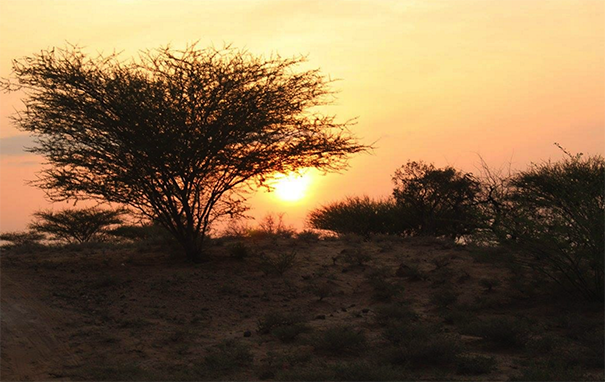
Karari Sunset (Photo Credit Lorena Benitez '16)
The Koobi Fora Field School has been training some of the best and brightest students for over 20 years. Many of them go on to a career in academia. Many are successful in a variety of other occupations. Here are just a few of the scholars that have spent hours recovering fossils from the Okote Member silts and made the hike out to the KNM-ER 1470 site.

Holly Dunsworth
After KFFS in 1998, I had one more year left at the University of Florida. That’s when I wrote my honors thesis on Homo erectus cranial variation with Dr. Susan Anton. Then, in 1999, I began graduate school with Alan Walker at The Pennsylvania State University. Just after finishing my dissertation on Proconsul (a.k.a. Ekembo) foot function and growth, I began co-directing a field project at the Miocene and Pleistocene sites of Rusinga Island, Kenya. Those many weeks at Koobi Fora prepared me well! (I never didn't have a secret stash of M&Ms. And who cares about a puncture or seven? And here's to the stamina to stare at the ground for hours on end, and to sling bucket after bucket of dirt!) Since those many wonderful expeditions to Rusinga, my research interests have become more philosophical, turning towards narratives of human evolution (like the "obstetrical dilemma" and the sexual selection explanation for sex differences in height). Human evolutionary storytelling is the theme of my upcoming book (which I've very much enjoyed writing), and I've been happily teaching at the University of Rhode Island since 2011. I’d do the KFFS over and over again in a heartbeat.
Current Position: Professor of Anthropology, University of Rhode Island

Degsew Mekonnen
I was a Koobi Fora Field School alumnus in 2017. At that time, I was completing my MA. The Koobi Fora Field School equipped me well with paleoenvironmental reconstruction methodologies, strengthened my field experience, and expanded my connections with researchers across the globe. Since then, I have earned a second master’s degree from the University of Sapienza, Rome, and joined a PhD program in archaeology at the Interdisciplinary Center for Archaeology and the Evolution of Human Behaviour (ICArEHB). My research focuses on the beginnings of agriculture in Ethiopia using paleoenvironmental, plant genetics, and archaeological approaches. I am currently affiliated with the Ethiopian Heritage Authority and pursuing postdoctoral positions while awaiting my PhD viva.
Current Position: Archaeology Researcher at Ethiopian Heritage Authority

Lorena Benitez
Lorena attended the Koobi Fora Field School in 2016, which solidified her love for working African landscapes. She completed her masters in Environmental Science from Yale University in 2020 where her research focused on the interactions between elephants and fruit trees in Kibale National Park, Uganda. Lorena is currently studying African landscape ecology as a PhD student at the University of Edinburgh. Between degrees, Lorena worked as a researcher at the Smithsonian Conservation Biology Institute and Socio-Ecological Observatory for Studying African Woodlands.
Current Position: PhD Student, University of Edinburgh

Niguss Baraki
I am a postdoctoral researcher in the department of Anthropology (CASHP) at GWU, working in the Stone Age Archaeology Lab. My research in Koobi Fora focuses on investigating the origins of technology and its evolutionary implications for hominin paleobiology. Specifically, I explore how the emergence and development of stone tool technology relate to morphological changes in the hominin hand. I am also interested in examining how technological innovations coincide with environmental transformations. With this work, I aim to understand the broader evolutionary feedback between behavior, anatomy, and ecology in human evolution.
Current Position: Postdoctoral Research at the Center for the Advanced Study of Human Paleobiology (CASHP), GWU

Wei Chu
Dr. Wei Chu is a Research Fellow at the University of Cologne specializing in the geoarcheology and site formation processes of Pleistocene Europe. His current research project is on the Upper Palaeolithic of the Eastern Mediterranean and Balkan Peninsula during the last glacial period. Dr. Chu’s past research has been on British and French Lower/Middle Palaeolithic sites. He is currently the editor of the Journal “Lithics.”
Marian Hamilton
Marian attended the Koobi Fora field school in 2013 after her first year in graduate school. She continued her exciting field research this year at Kibale National Park, Uganda. Her PhD research uses strontium isotopes to study the ranging behavior of male and female primates in Kibale National Park, Uganda. These modern baselines will be used as a model for hominin land use behaviors in a variety of habitats. Marian is currently a PhD student at the University of New Mexico and a recipient of the National Science Foundation’s Graduate Research Fellowship.
Scott Blumenthal
Scott is a PhD candidate at the Graduate Center of the City University of New York, New York. His dissertation work focuses on hominin paleoenvironments in eastern Africa; specifically, he uses isotope records from tooth enamel to study climate, vegetation, and mammalian ecologies. His field research includes reconstructing the Plio-Pleistocene environments at sites near modern Lake Victoria in Kenya. Scott has received numerous grants in support of his research including the NSF’s Doctoral Dissertation Improvement Grant and a Young Explorer’s Grant from the National Geographic. His recent work on gorillas was published in the prestigious Proceedings of the National Academy of Sciences.
Jenna Lavin
Jenna studied palaeoanthropology and participated in the Koobi Fora Field School from 2006 to 2009. She received her Masters degree from the UCT Department of Archaeology in 2010 and has, since then, been employed in the service of various heritage authorities, currently Heritage Western Cape. As the Assistant Director for Policy, Research and Planning, Jenna is responsible for the identification, declaration and conservation of new Provincial Heritage Sites. She is currently working on finishing her second Masters degree in Conservation of the Built Environment from the UCT Department of Architecture.

Kaedan O’Brien
Dr. Kaedan O'Brien is an Assistant Professor of Anthropology at SUNY Oneonta, specializing in paleoecology and mammal paleontology. He completed a Bachelor of Science in Anthropology and Zoology at the University of Wisconsin-Madison, and a Master of Science and Ph.D. in Biological Anthropology from the University of Utah.
Dr. O'Brien's research uses the hominin and large mammal fossil records and stable isotopes to address one central question: What were the paleoenvironmental drivers of human evolution in Africa? This research addresses (1) late Cenozoic mammal community structure, (2) the impact of scale on paleoenvironmental reconstruction, (3) isotopic evidence for prehistoric seasonality and migration, and (4) megafaunal extinction. Currently, he is involved in projects in the Turkana Basin, Tugen Hills, and Lemudong'o, Kenya at sites dating to the past 7 million years, along with Pleistocene sites in the Western Cape of South Africa.
At SUNY Oneonta, he teaches courses related to biological anthropology, paleoenvironments, and the links between science and traditional ecological knowledge.
Current Position: Assistant Professor, SUNY Oneonta
J. Tyler Faith
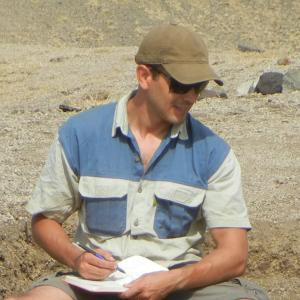
Tyler Faith attended the Koobi Fora Field School in 2004. He went on to obtain his Ph.D. in Hominid Paleobiology (2011) from The George Washington University and was a Lecturer (= Assistant Professor) in Archaeology at the University of Queensland in Australia. He is now a Professor in Anthropology at the University of Utah. He currently directs fieldwork exploring Middle-to-Late Pleistocene archaeology, paleontology, and paleoenvironments in southern and western Kenya
Current Position: Professor, University of Utah